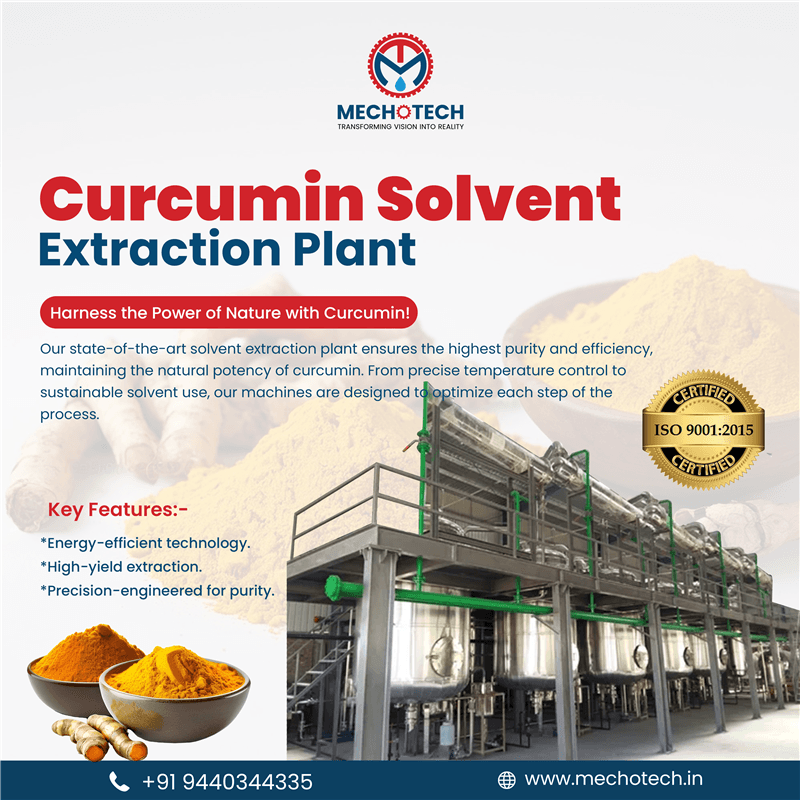
Ethanol is an important extraction medium in the botanical processing industry because it can dissolve a broad range of plant constituents and can be recovered and reused when the process is properly engineered. From standardized herbal extracts and nutraceutical ingredients to phytochemicals, natural colours and specialty ingredients, ethanol-based extraction provides a versatile commercial platform. However, an industrial ethanol extraction plant involves much more than an extraction vessel — it requires careful integration of raw-material preparation, extraction, filtration, solvent recovery, vacuum concentration, purification, drying, solvent storage, process automation and safety engineering. Mechotech designs customized turnkey extraction systems according to the customer's botanical material, capacity, product specification, solvent system, automation requirements and applicable standards.
✓Key Takeaways
- →Ethanol dissolves a broad range of plant constituents and its selectivity can be tuned via the ethanol-to-water ratio.
- →An industrial ethanol plant integrates extraction, filtration, vacuum evaporation, condensation, recovery and reuse as one closed loop.
- →Solvent recovery is critical to economics — including desolventizing ethanol retained in spent solids.
- →Because ethanol is flammable, hazardous-area design, vapour monitoring, pressure relief and emergency shutdown are mandatory.
- →PLC/SCADA automation controls the solvent loop and detects abnormal losses.
- →Mechotech engineers ethanol plants that treat solvent as a circulating resource, not a disposable input.
1What Is Ethanol Extraction and Why Ethanol?
Ethanol extraction uses ethanol, or an ethanol-water mixture, to transfer selected soluble compounds from botanical raw material into a liquid extract. Depending on concentration and process conditions, ethanol can extract various classes of plant constituents, offering broad extraction capability, compatibility with many botanical processes, the ability to tune selectivity by adjusting the ethanol-to-water ratio, recoverability through distillation, and suitability for scalable processing integrated with vacuum evaporation. Its suitability must always be assessed against the target compound and final product requirements.
2The Ethanol Extraction Process
An industrial ethanol extraction line runs as an integrated sequence with solvent recovery built in:
- Raw Material & Ethanol Preparation: Botanicals are cleaned, sorted, cut, crushed, ground and moisture-adjusted to an optimum particle size, and the ethanol or ethanol-water mixture is prepared to the concentration required for the target compounds.
- Extraction: Prepared material is contacted with the ethanol medium under controlled concentration, solvent-to-solid ratio, temperature, time, agitation and number of stages — via batch, continuous or rotary systems depending on volume and flexibility needs.
- Separation & Filtration: The liquid extract is separated from spent solids and clarified through bag, cartridge, sparkler or pressure-leaf filters, protecting downstream heat exchangers and evaporators.
- Vacuum Evaporation & Condensation: Ethanol is removed under vacuum at low temperature to protect heat-sensitive constituents, and the ethanol vapour is condensed back to liquid — efficient condensation being critical to minimise solvent loss.
- Ethanol Recovery & Reuse: Recovered ethanol is collected, evaluated for concentration, water content and contaminants, and returned to subsequent extraction cycles when it meets process specifications — creating a closed recovery loop with major economic impact.
- Concentrate Processing & Drying: The concentrated extract proceeds to purification, standardization, blending and drying (spray or vacuum tray), and a desolventizing stage can recover residual ethanol retained in spent solids.
3Why Solvent Recovery Is Critical
Ethanol is a recurring operating expense, and without effective recovery, solvent losses significantly increase production cost. An engineered recovery system reduces fresh ethanol purchases, reduces waste, improves process economics, reduces solvent-handling requirements and supports more sustainable manufacturing. Recovery efficiency depends on plant design, operating conditions, solvent concentration and product characteristics — and recovering ethanol retained in spent botanical solids via a desolventizing stage further improves total recovery and safety.
4Applications, Safety and Automation
Ethanol systems suit ashwagandha, turmeric, boswellia, green tea, ginger, amla, moringa, licorice, polyphenol extracts, natural colours, spice extracts and selected phytochemicals. Because ethanol is flammable, industrial plants require closed solvent transfer, hazardous-area electrical equipment, earthing and bonding, ventilation, vapour monitoring, pressure relief, emergency shutdown and fire protection — established through project-specific risk assessment. PLC and SCADA automation controls ethanol charging, extraction, transfers, evaporation, recovery, cleaning and solvent inventory, giving consistency, traceability and abnormal-loss detection.
5Why Choose Mechotech
Mechotech develops customized ethanol, herbal, nutraceutical and phytochemical extraction plants, batch, continuous and rotary extractors, oleoresin plants, solvent recovery systems, vacuum and multi-effect evaporators, spray dryers, CIP and PLC/SCADA automation — covering engineering, manufacturing, plant integration, installation, commissioning, operator training and technical support. A well-engineered plant treats ethanol as a circulating process resource rather than a disposable input.
Frequently Asked Questions
Why is ethanol commonly used for botanical extraction?+
Can recovered ethanol be reused?+
Is ethanol extraction suitable for nutraceutical products?+
Can ethanol extraction plants be automated?+
Is ethanol extraction safe?+
Conclusion
An ethanol extraction plant provides a highly versatile manufacturing platform for herbal, nutraceutical, phytochemical, natural ingredient and botanical extract production. Its commercial success depends not only on extraction yield but on solvent recovery efficiency, energy consumption, automation, process safety, product quality and downstream integration. A well-engineered plant recovers and reuses ethanol wherever technically and quality-wise appropriate. Mechotech develops customized turnkey extraction systems integrating extraction, filtration, vacuum concentration, solvent recovery, drying, CIP, automation and supporting process engineering.
Ready to Build Your Extraction Plant?
Mechotech engineers are ready to design the perfect plant for your application.
Get a Free Consultation.jpeg&w=1920&q=75)