The global herbal, nutraceutical, pharmaceutical and botanical industries depend on efficient extraction technology to produce high-quality herbal extracts. The quality of the final extract depends not only on the raw material but on every stage of the manufacturing process — and a well-designed plant delivers higher yield, better consistency, lower operating cost and compliance with international standards. This guide explains the complete herbal extraction process step by step, from raw material procurement to packaging and quality control. At Mechotech, we design and manufacture turnkey herbal extraction plants that combine advanced engineering, automation and GMP-compatible design to make each of these steps reliable and repeatable.
✓Key Takeaways
- →Herbal extraction separates bioactive compounds from plant material using water, ethanol or hydro-alcoholic solvents — the final quality depends on every process stage, not just the raw material.
- →The full process runs 13 controlled steps: from procurement and cleaning through extraction, filtration, concentration, solvent recovery, drying, standardization, packaging and quality control.
- →Vacuum concentration lowers boiling temperature to protect heat-sensitive compounds while saving energy.
- →Standardization (adjusting concentration, blending and analytical verification) is what guarantees batch-to-batch consistency of active levels.
- →PLC/SCADA automation delivers process consistency, traceability and the documentation GMP manufacturing requires.
- →A well-engineered process yields more, costs less to run, and is easier to keep compliant — the core of a Mechotech turnkey plant.
1What Is Herbal Extraction?
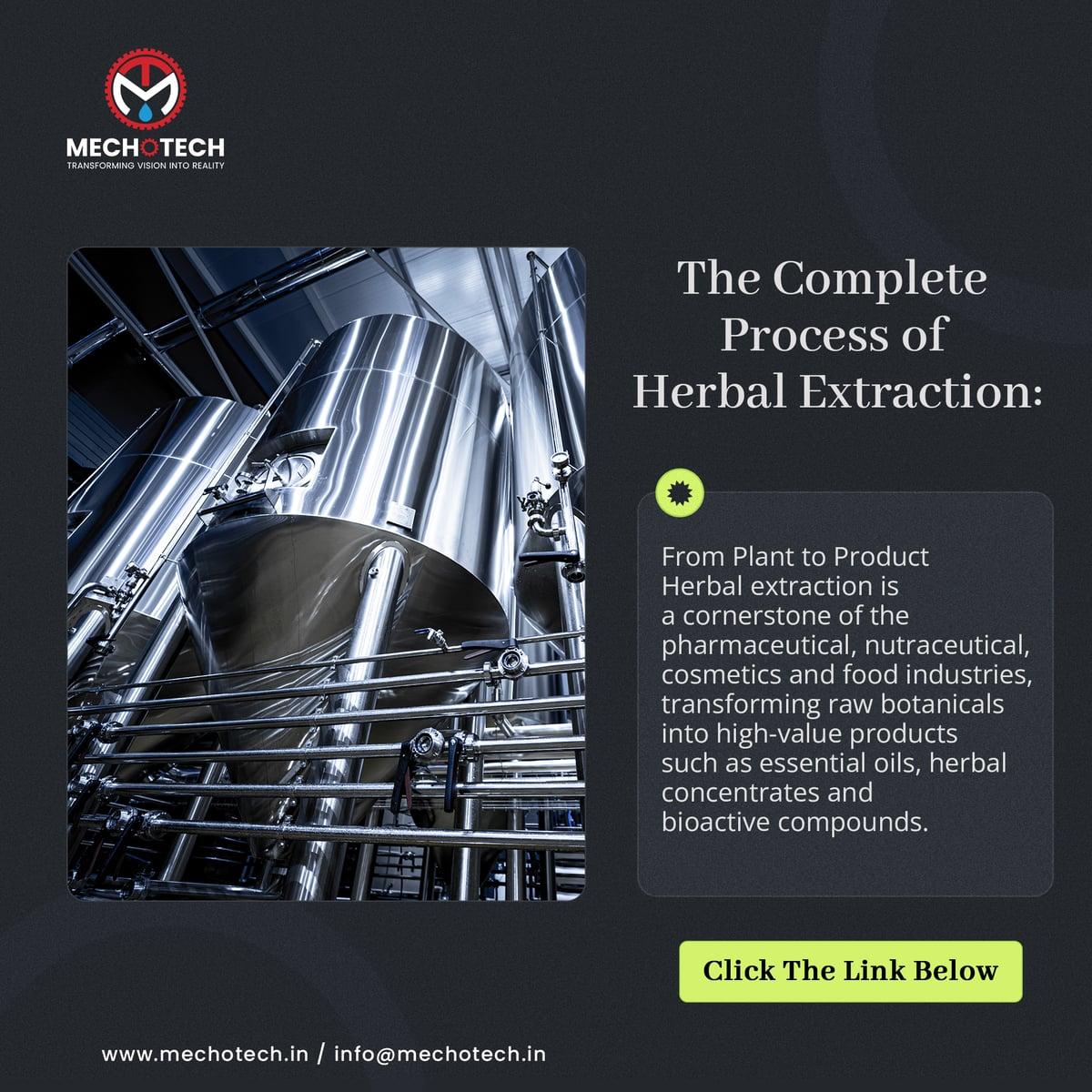
Herbal extraction is the process of separating valuable bioactive compounds from plant materials using a suitable solvent such as purified water, ethanol or a hydro-alcoholic mixture. The objective is to obtain a concentrated extract rich in active constituents while removing unwanted plant fibres and impurities. Achieving that consistently requires controlling every processing step — the sequence below shows how a modern plant does it, from plant to product.
2The Herbal Extraction Process, Step by Step
A complete extraction line moves the botanical through thirteen distinct, controlled stages. Each step feeds the next, and the parameters at every stage directly influence final yield, purity and consistency:
- Step 1 — Raw Material Procurement & Inspection: High-quality botanicals are selected and checked for botanical identity, moisture content, foreign matter, microbial quality, active-compound content and appearance. Quality raw material is the foundation of consistent extract quality.
- Step 2 — Cleaning & Sorting: Vibratory screens, destoners, magnetic separators and washing systems remove dust, stones, sand, metal particles and foreign plant matter — protecting downstream equipment and improving product quality.
- Step 3 — Cutting, Crushing or Pulverizing: The material is reduced to an appropriate particle size to increase surface area, improve solvent penetration, speed extraction and raise yield. Particle size is chosen to suit the botanical and the process.
- Step 4 — Loading the Extractor: Prepared material is transferred into the extraction vessel — equipped with steam jacket, agitator, temperature control, pressure and vacuum capability and PLC automation — with even loading ensuring uniform extraction.
- Step 5 — Solvent Addition: The selected medium (purified water, food-grade ethanol or a hydro-alcoholic mixture) is introduced, with the solvent-to-material ratio carefully controlled for optimum extraction efficiency.
- Step 6 — Extraction: The solvent dissolves the desired phytochemicals from the plant material. Temperature, pressure, extraction time, agitation speed and solvent ratio are held within specified limits by automation for batch-to-batch consistency.
- Step 7 — Filtration: The liquid extract is separated from spent plant material using bag, sparkler, pressure-leaf or cartridge filters, improving downstream processing and product clarity.
- Step 8 — Concentration: Excess solvent is removed under vacuum using falling-film, vacuum or forced-circulation evaporators — protecting heat-sensitive compounds while reducing energy consumption.
- Step 9 — Solvent Recovery: Where ethanol or another recoverable solvent is used, it is separated, condensed and collected for reuse — lowering solvent consumption and operating cost while improving sustainability.
- Step 10 — Drying: The concentrated extract is converted to a stable powder or semi-solid using a vacuum tray dryer, spray dryer or fluid bed dryer, chosen to suit the product characteristics.
- Step 11 — Standardization: Many extracts are standardized to consistent active-compound levels by adjusting concentration, blending batches and verifying by analytical testing — ensuring batch-to-batch consistency.
- Step 12 — Packaging: The finished extract is packed hygienically in HDPE drums, fibre drums, food-grade bags or aluminium foil packs to protect it during storage and transport.
- Step 13 — Quality Control: Testing runs throughout the process — appearance, moisture, active marker analysis, microbial testing, heavy metals, residual solvents, bulk density and particle size — to ensure reliable product performance.
3Automation in Modern Herbal Extraction Plants
Automation is what turns a good process into a repeatable one. PLC and SCADA systems enable real-time monitoring and precise process control, improving process consistency, production efficiency and batch traceability while handling data recording, alarm management, recipe control and regulatory documentation. The result is fewer manual errors and a complete, auditable record of every batch — essential for GMP-oriented manufacturing.
4Advantages of a Modern Extraction Process & Why Mechotech
A well-engineered extraction process delivers higher yield, better product quality, lower solvent consumption, reduced energy cost, improved operator safety, faster production cycles, consistent batch quality and easier regulatory compliance. Mechotech offers complete turnkey solutions across herbal, nutraceutical and phytochemical extraction plants, oleoresin plants, essential oil distillation plants, solvent recovery systems, vacuum evaporation systems, drying systems, PLC and SCADA automation and GMP-compatible plant design — supporting every stage from concept and engineering through installation and commissioning.
Frequently Asked Questions
Which solvent is best for herbal extraction?+
Why is vacuum concentration preferred?+
Can one extraction plant process different herbs?+
Is automation necessary for herbal extraction plants?+
Does Mechotech provide turnkey extraction projects?+
Conclusion
The herbal extraction process involves far more than soaking herbs in a solvent — every stage, from raw material preparation to packaging and quality control, plays a crucial role in determining product quality, extraction efficiency and profitability. With advanced engineering, customised process design and world-class manufacturing capability, Mechotech helps customers establish efficient, reliable and future-ready extraction facilities built for the evolving demands of the global herbal and nutraceutical industries. Ready to build your next extraction plant? Our team can design a customised turnkey solution engineered for superior performance, quality and long-term success.
Ready to Build Your Extraction Plant?
Mechotech engineers are ready to design the perfect plant for your application.
Get a Free Consultation