.jpeg&w=1920&q=75)
Selecting the correct extraction technology is one of the most important decisions when establishing a herbal, nutraceutical, phytochemical, oleoresin, flavour, fragrance or botanical ingredient facility. Two technologies frequently considered are Supercritical CO2 Extraction (SCFE) and conventional solvent extraction. Both can produce high-value ingredients, but their operating principles, capital requirements, selectivity, throughput, downstream processing and economics differ significantly. There is no universally superior technology — the correct choice depends on raw material, target compounds, required purity, capacity, product value, solvent restrictions, operating cost and target market. Mechotech develops customized botanical processing solutions based on these technical and commercial considerations.
✓Key Takeaways
- →Neither technology is universally superior — the right choice depends on the target compound, purity, capacity, product value and market.
- →Supercritical CO2 excels for lipophilic and premium compounds and separates cleanly after depressurization, but has higher capital complexity.
- →Conventional solvent extraction is versatile, scalable and often more economical for polar compounds and high-volume production.
- →Both can be highly selective and produce high-quality extracts when properly engineered.
- →Technology should follow the product strategy; pilot trials de-risk the decision.
- →Mechotech engineers conventional (and hybrid) extraction plants matched to raw-material chemistry and commercial objectives.
1What Is Supercritical CO2 Extraction?
Supercritical fluid extraction uses carbon dioxide under conditions above its critical temperature and pressure, where CO2 exhibits properties useful for extraction. Under controlled conditions, supercritical CO2 penetrates botanical material and dissolves selected compounds; reducing the pressure afterwards allows the CO2 to separate from the extracted compounds. This provides an important advantage — the extraction medium can be removed without the conventional solvent evaporation required for many liquid organic solvents. It is particularly attractive for lipophilic compounds such as essential oil fractions, aromatics, lipids, specialty oleoresins and premium botanical ingredients, and can operate with comparatively low thermal exposure.
2What Is Conventional Solvent Extraction?
Solvent extraction uses a liquid medium — water, ethanol, hydro-alcoholic mixtures or other application-specific solvents — to dissolve desired compounds from botanical raw materials. After extraction, the solvent is generally separated using evaporation, distillation and condensation. It is highly versatile and scalable, widely applied to herbal extracts, Ayurvedic and nutraceutical ingredients, phytochemicals, polyphenol-rich extracts, natural colours, spice extracts and botanical ingredients, and is often the simpler, more economical route for highly polar compounds best extracted with water or ethanol-water.
3Key Differences: Selectivity, Cost and Throughput
The two technologies differ across several dimensions that determine the right fit:
- Selectivity: SCFE selectivity is tunable through pressure, temperature and CO2 flow (with optional co-solvents); solvent extraction achieves selectivity through solvent choice, concentration, temperature, time and pH — both can be highly selective when properly engineered.
- Capital & Operating Cost: SCFE operates at very high pressure requiring specialized vessels, pumps, valves and controls, generally giving higher capital cost; conventional solvent extraction usually has lower capital complexity, though operating cost in both cases requires a detailed mass and energy balance.
- Residual Solvent & Product Quality: CO2 separates readily after depressurization, while solvent extraction requires appropriate solvent-removal and residual-solvent controls; both can produce high-quality extracts when raw material, temperature, purification and drying are properly managed.
- Throughput & Downstream Processing: For high-volume commodity extracts, conventional batch, continuous or rotary solvent extraction often offers strong throughput economics; SCFE is attractive for higher-value selective products, and each requires different downstream processing (evaporation and solvent recovery vs separation and fractionation).
4Choosing by Product and Compound Type
The technology should follow the product strategy, not the other way around. High-volume botanical extract favours conventional extraction; a premium lipophilic extract may deserve serious CO2 consideration; polar herbal extracts suit water or hydro-alcoholic extraction; a multi-product facility favours flexible batch solvent extraction; and high-volume standardized products favour continuous or rotary extraction. In some sophisticated facilities, different technologies are used sequentially to obtain multiple fractions from the same raw material. Pilot trials help establish yield, selectivity, product quality and downstream requirements before committing to a large plant.
5Why Conventional Extraction Remains Important and Why Mechotech
Conventional extraction continues to dominate many industrial applications because of its process flexibility, wide solvent selection, proven scalability, high production capacity and ability to process diverse botanicals — and modern automation, vacuum processing, solvent recovery and energy integration make these plants highly sophisticated. Mechotech develops customized processing solutions including herbal, nutraceutical, phytochemical, oleoresin and natural colour plants, batch, continuous and rotary extractors, solvent recovery, vacuum and multi-effect evaporators, spray dryers, CIP and PLC/SCADA automation — with full turnkey project scope.
Frequently Asked Questions
Is supercritical CO2 extraction better than ethanol extraction?+
Is CO2 extraction completely solvent-free?+
Which technology has lower investment?+
Which is better for large-scale production?+
Does Mechotech provide turnkey botanical extraction plants?+
Conclusion
The choice between supercritical CO2 and conventional solvent extraction should be based on scientific, engineering and commercial analysis — not on which technology appears more advanced. Supercritical CO2 provides excellent selectivity for suitable high-value, particularly lipophilic, compounds, while conventional solvent extraction remains highly versatile and scalable for herbal extracts, nutraceuticals, phytochemicals, natural colours and oleoresins. For many manufacturers, the optimal solution involves different technologies for different product categories. Mechotech develops customized botanical processing plants based on raw-material chemistry, capacity, yield, purity, solvent requirements, energy, automation, safety and long-term objectives.
Ready to Build Your Extraction Plant?
Mechotech engineers are ready to design the perfect plant for your application.
Get a Free Consultation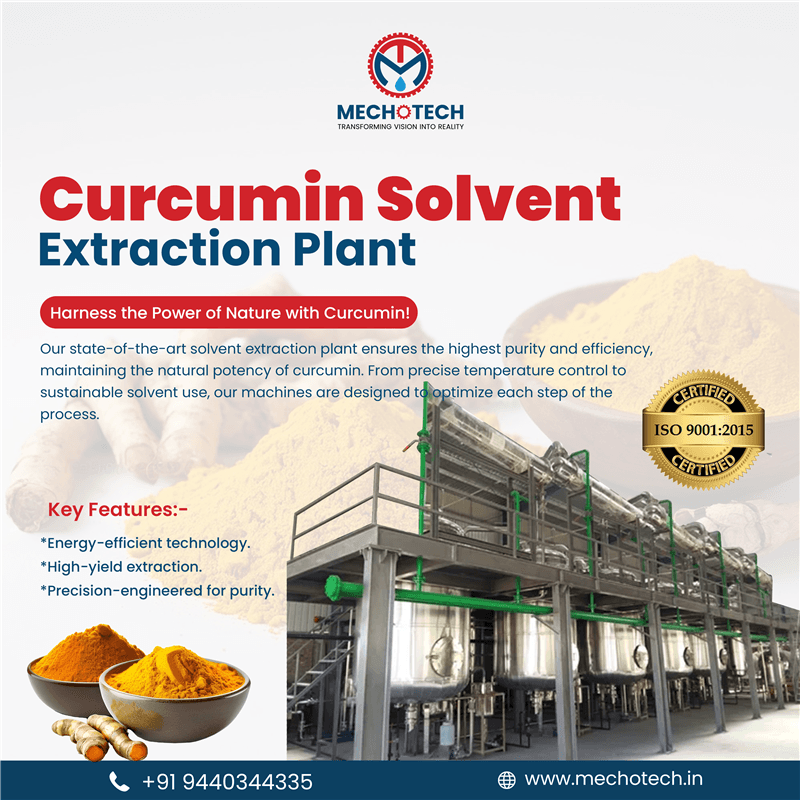
.jpeg&w=1920&q=75)