.jpeg&w=1920&q=75)
Food manufacturers increasingly want integrated solutions that convert agricultural raw materials into consistent, value-added products at commercial scale. A successful food-processing project requires much more than individual machines: preprocessing, thermal processing, drying, material handling, utilities, automation, hygiene, packaging interfaces and plant layout must work together as one system. Mechotech provides engineering and equipment solutions for food processing, fruit and vegetable dehydration, botanical processing, extraction, distillation and related industrial applications.
✓Key Takeaways
- →A turnkey food plant is engineered around a defined raw material and product, not assembled from standard machines.
- →Coordinated engineering avoids mismatched capacities, poor material transfer and bottlenecks.
- →Core stages span preparation, dehydration, extraction, evaporation and distillation, matched to the product.
- →Utilities must be sized for simultaneous loads, or the plant cannot reach its rated capacity.
- →Multi-product design and expansion provisions improve utilization for seasonal crops.
- →Mechotech integrates food, dehydration, extraction and distillation into one coordinated turnkey facility.
1What Is a Turnkey Food Processing Plant?
A turnkey food-processing plant is an integrated facility engineered around a defined raw material and finished product. Depending on the application, the sequence may include raw-material receiving, sorting, cleaning, washing, size reduction, processing, separation, concentration or drying, cooling, product handling and packing. The equipment configuration should be determined by the product rather than selecting standard machinery first and adapting the process later.
2Why Choose a Turnkey Approach?
A food-processing facility often contains equipment from several technical disciplines, and when these sections are engineered independently, manufacturers face mismatched capacities, inefficient material transfer, insufficient utilities and production bottlenecks. A coordinated turnkey approach integrates process flow, equipment capacity, piping, electrical requirements, instrumentation, utilities, layout, installation and commissioning from the beginning — providing a clearer path from raw material to commercial production.
3Core Processing Stages
A commercial food plant integrates complementary processing technologies matched to the product:
- Receiving & Preparation: Sorting, washing, peeling, cutting, crushing and grinding, sized to peak raw-material availability rather than only average production — important for seasonal crops.
- Dehydration & Drying: Controlled temperature, airflow, humidity and residence time bring the product to the required moisture while preserving colour, flavour and texture.
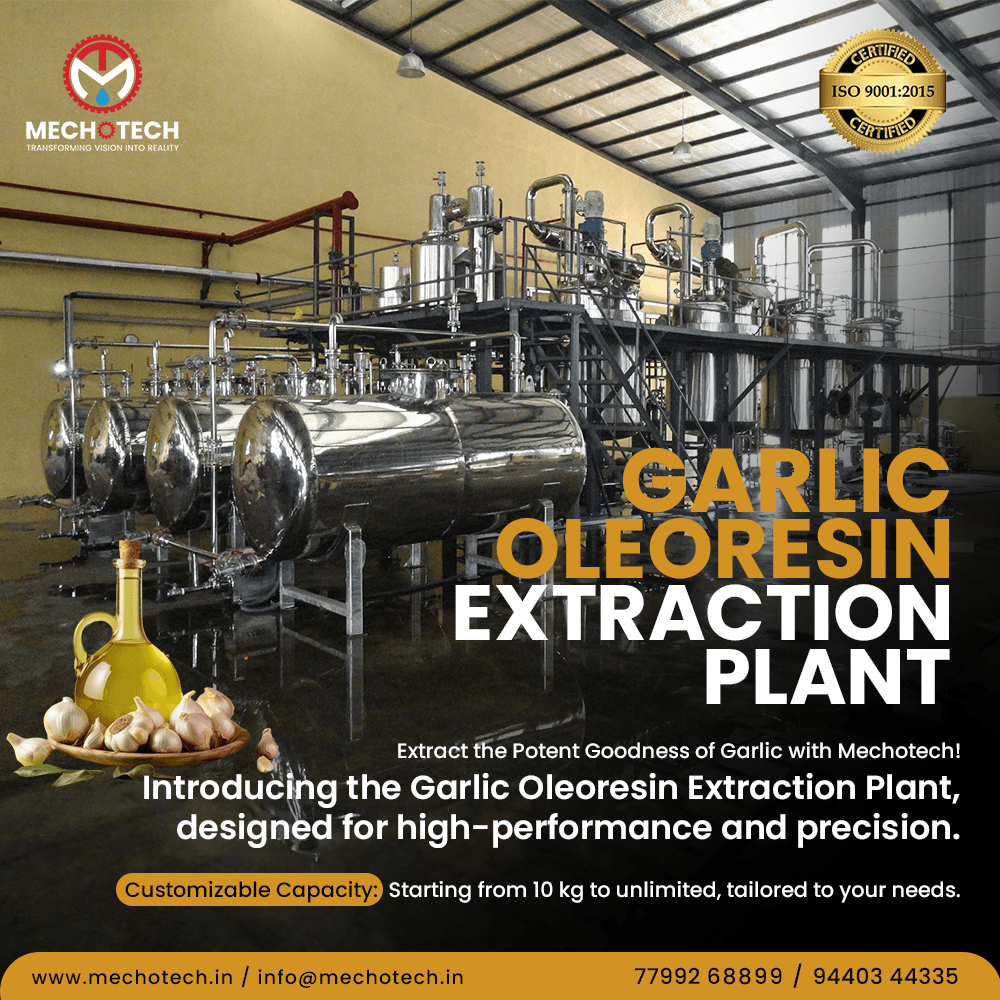
- Extraction for Value-Added Ingredients: Herbs, spices, fruits, vegetables and flowers can be processed into extracts, colours, flavours, oleoresins or aromatic oils using batch, rotary or continuous extraction with filtration and concentration.
- Evaporation & Distillation: Vacuum evaporation concentrates temperature-sensitive liquid streams, and steam or hydro distillation with cohobation and oil-water separation produces aromatic products.
- Solvent Recovery: Where recoverable solvents are used in extraction, evaporation, condensation, distillation, storage and recovery can be integrated, with recovered solvent reused only when it meets requirements.
4Utilities, Layout and Hygiene
Utilities are frequently underestimated: a commercial facility may require steam, hot water, cooling water, chilled water, compressed air, electricity, process water, vacuum, ventilation and wastewater handling, all sized for simultaneous operating loads. An efficient layout progresses logically from raw-material zone through preparation, processing and finished-product handling to packing and storage, with personnel movement, waste handling, maintenance space and future expansion considered. Hygienic design — suitable food-contact materials, accessible cleaning, drainage, contamination control and product-flow segregation — is fundamental.
5Multi-Product, Expansion, Economics and Why Mechotech
Because many crops are seasonal, multi-product facilities that process different materials across seasons can improve utilization, provided compatibility, cleaning, cross-contamination and scheduling are managed. Plant layout, utilities, electrical capacity, piping headers and automation architecture can incorporate expansion provisions. A technologically sophisticated plant succeeds commercially only when the process economics — raw-material cost, yield, utilities, labour, packaging, maintenance and plant utilization — are sustainable. Mechotech provides customized food, botanical, extraction, dehydration and distillation solutions integrated into one coordinated facility.
Frequently Asked Questions
What is included in a turnkey food-processing plant?+
Can a single plant process multiple agricultural products?+
Can food-processing plants include extraction and dehydration technologies?+
Why is utility planning so important?+
Who manufactures customized food-processing plants in India?+
Conclusion
The commercial opportunity in food processing comes from increasing the value generated from agricultural raw materials — fresh produce into dehydrated product into powder into standardized ingredient, or spice into essential oil or oleoresin into specialized ingredient. The optimum route depends on raw-material availability, process yield, market demand, investment and target customers, and the whole facility must be engineered as one integrated system. Mechotech engineers customized turnkey food-processing plants around the customer's raw material, desired product, capacity, utilities, quality requirements and expansion strategy.
Ready to Build Your Extraction Plant?
Mechotech engineers are ready to design the perfect plant for your application.
Get a Free Consultation.jpeg&w=1920&q=75)