With four principal extraction technologies available — solvent extraction, steam distillation, supercritical CO₂ extraction, and cold pressing — selecting the right method for your specific application is one of the most consequential decisions in herbal processing plant design. The wrong technology choice can result in low yields, regulatory non-compliance, excessive capital expenditure, or a final product that fails to meet buyer specifications. Each method is best suited to a specific class of target compounds, a particular regulatory environment, and a defined production scale, and no single technology is universally optimal. This guide provides a structured, technically grounded framework for matching extraction technology to your raw material, target compound, industry, and commercial scale.
✓Key Takeaways
- →Solvent extraction (ethanol, hexane, acetone) is the best choice for non-volatile compounds at scale — scalable to 10,000+ kg/day for curcumin, oleoresins, alkaloids, and standardised phytochemical extracts.
- →Steam distillation at 0.3–1.0 bar is the industry standard for volatile essential oils — solvent-free, food-grade accepted, yielding 0.05–10% essential oil depending on species.
- →Supercritical CO₂ extraction operates at 35–45°C with zero solvent residue — ideal for heat-sensitive pharmaceutical and premium cosmetic applications — at 3–5× the capital cost of solvent extraction.
- →Cold pressing is viable only for oil-rich materials (citrus peel, seeds) — completely mechanical, no heat or solvent, preserves heat-sensitive antioxidants and natural fragrance compounds.
- →Technology selection must be driven by the target compound class first, then regulatory environment, then production scale, and finally budget — not the other way around.
- →Mechotech engineers industry-specific plants for pharmaceutical (GMP), nutraceutical (FSSAI), food (Codex-compliant solvents), cosmetic (low-temperature), and essential oil sectors from its Hyderabad manufacturing facility.
1Why the Choice of Extraction Technology Matters
The extraction method determines not just yield and purity, but also regulatory permissibility, capital cost, operating cost per kilogram, and the downstream processing steps required to reach the final product specification. A manufacturer targeting 95% curcumin for pharmaceutical export cannot use cold pressing; a citrus essential oil producer cannot use solvent extraction for their peel oil without incurring unnecessary cost and complexity. Understanding which technology is appropriate for which application prevents costly retrofits, regulatory failures, and the production of off-specification material that cannot be sold at the intended price point. The following evaluation criteria must all be assessed before committing to a technology.
- Type of Bioactive Compound: Alkaloids, flavonoids, and polyphenols (non-volatile) are best extracted by solvent methods using ethanol, acetone, or hexane depending on their polarity. Essential oils and volatile terpenes require steam distillation or cold pressing. Heat-sensitive volatile compounds in pharmaceutical extracts may require supercritical CO₂. Each compound class has a preferred solvent system that maximises yield while minimising co-extraction of unwanted matrix compounds.
- Heat Sensitivity: Heat-labile compounds — including certain alkaloids, unstable polyphenols, and light-sensitive flavonoids — degrade at temperatures above 50°C, requiring low-temperature processing. Supercritical CO₂ extraction operates at 35–45°C, making it ideal for these compounds. Some solvent systems can also operate at ambient temperature but at the cost of longer extraction times and potentially lower selectivity.
- Production Scale: Scale dramatically affects technology economics. Solvent extraction is readily scalable to 10,000+ kg of raw material per day using multi-vessel extraction batteries with continuous counter-current operation. Steam distillation scales well for essential oil production from 50 kg/batch to 2,000 kg/batch. Supercritical CO₂ scales with difficulty and high capital cost — large CO₂ plants require massive high-pressure vessel investment. Cold pressing is limited in throughput by the mechanical capacity of the press.
- Regulatory Compliance: GMP and WHO standards for pharmaceutical herbal extracts restrict permissible solvents (per ICH Q3C), require validated cleaning procedures, and mandate batch documentation. Food-grade applications must use FSSAI/GRAS-approved solvents — ethanol, water, and hexane within Codex limits. EU Organic certification requires only compliant process aids. Understanding your target market's regulatory framework before selecting a technology prevents the expensive discovery that your process is non-compliant after equipment purchase.
- Budget and Energy Goals: Solvent extraction offers the lowest capital cost per tonne of throughput and is the most appropriate choice for large-volume commodity extracts such as curcumin, oleoresins, and standardised herbal powders. CO₂ extraction costs 3–5× more in capital than equivalent solvent extraction capacity, but the extract commands a significant market premium. Cold pressing has low operating cost but limited versatility. Steam distillation is capital-moderate and operating-cost-effective for essential oil applications.
2Popular Herbal Extraction Technologies Compared
Each extraction technology has a defined set of applications where it is the preferred or only viable choice. Understanding the technical parameters of each method — solvents used, operating conditions, typical yields, regulatory status, and capital cost profile — enables an objective comparison for any specific extraction project. The four technologies described below cover the full range of commercial herbal extraction applications from large-volume commodity production to premium pharmaceutical-grade speciality extracts.
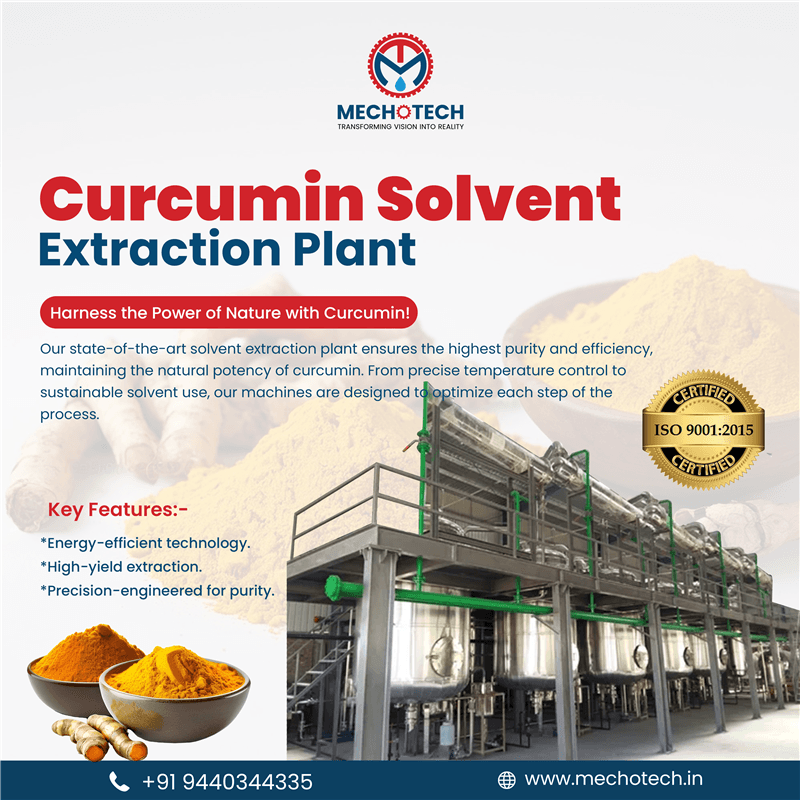
- Solvent Extraction: Solvent extraction uses food-grade solvents — primarily ethanol (for food and pharmaceutical applications), hexane (for oleoresins and fixed oils), or acetone (for curcumin and high-yield applications) — to dissolve non-volatile bioactive compounds from milled plant material. It is the preferred method for large-scale herbal processing at 500–10,000+ kg/day and delivers high extraction efficiency for polyphenols, alkaloids, glycosides, and resins. Closed-loop solvent recovery with greater than 95% efficiency is standard in modern plants, making the operating cost of solvent economically manageable. Applications include curcumin from turmeric, piperine from black pepper, sennosides from senna, and all major oleoresins.
- Steam Distillation: Steam distillation at 0.3–1.0 bar is the industry-standard method for extracting volatile essential oils from aromatic plant material — lemongrass, citronella, ajwain, eucalyptus, lavender, rose, and similar crops. It produces solvent-free essential oil with no chemical contamination risk, and the process is universally accepted as food-grade and pharmaceutical-grade without restriction. Typical oil yields range from 0.05% (rose petals) to 10% (clove buds) depending on the species and plant part. Steam distillation is not appropriate for non-volatile compounds such as curcumin, piperine, or alkaloids, which do not volatilise with steam.
- Supercritical CO₂ Extraction: Supercritical CO₂ extraction operates above CO₂'s critical point (31.1°C, 73.8 bar), where it exhibits liquid-like solvating power with gas-like diffusivity. Operating temperature of 35–45°C makes it suitable for heat-sensitive compounds that degrade under solvent extraction conditions. When pressure is released, CO₂ reverts to gas and evaporates completely, leaving a zero-residue, premium-grade extract. Capital cost is 3–5× that of equivalent solvent extraction capacity due to the high-pressure vessel engineering required. CO₂ extraction is the method of choice for premium pharmaceutical botanical extracts, high-value cosmetic actives, and hops extraction for craft brewing — wherever zero solvent residue is a hard regulatory or commercial requirement and the extract price justifies the plant investment.
- Cold Press Extraction: Cold pressing is a purely mechanical extraction method that uses hydraulic or expeller-type presses to squeeze oil from oil-rich plant material — primarily citrus peel (lemon, orange, bergamot essential oils), neem seed, moringa seed, flaxseed, and similar high-oil-content materials. Because no heat or solvents are used, cold-pressed oils retain heat-sensitive antioxidants, fragrance compounds, and natural colour that would be degraded by thermal processing. The limitation is that cold pressing is only applicable to plant materials with substantial oil content (typically greater than 15% oil); it is not suitable for extracting low-concentration compounds from leaves, bark, or roots. Throughput is limited by press capacity.
3How to Select the Right Technology for Your Project
Technology selection should follow a structured decision sequence that begins with the target compound and works outward through regulatory requirements, scale, and budget — not the other way around. Beginning with budget or preferring a technology because it is familiar or commonly used can lead to an extraction plant that is technically capable but commercially suboptimal. The following five-step evaluation process is the framework we use with all clients at the project definition stage.
- Identify Your Raw Material: Leafy herbs (tulsi, neem, moringa), woody bark and roots (turmeric, ashwagandha, liquorice), seeds and nuts (moringa, castor, flaxseed), fresh flowers (rose, jasmine, marigold), and aromatic grasses (lemongrass, vetiver) each have different physical properties, oil content levels, and compound classes — all of which directly determine which extraction approach is technically feasible and economically optimal.
- Define Your Target Extract: Is the commercial product a volatile essential oil (steam distillation), a standardised phytochemical extract with a defined bioactive percentage (solvent extraction + purification), a cold-pressed vegetable oil (mechanical pressing), or a pharmaceutical-grade zero-residue extract (CO₂ extraction)? Each end product maps to one primary technology, and clarity on the target product specification is the prerequisite for any meaningful technology evaluation.
- Confirm Production Capacity: Match plant capacity to realistic market projections rather than maximum possible demand. A pilot plant operating at 50–200 kg of raw material per day is appropriate for product development, regulatory dossier generation, and market seeding. Semi-commercial scale of 500–2,000 kg/day supports market entry and customer qualification. Commercial scale of 2–20 tonnes/day is appropriate for established brands with confirmed off-take agreements. Over-investing in capacity before market validation is a common and expensive mistake.
- Evaluate Budget and ROI: Solvent extraction offers the best capital-expenditure-to-output ratio for most commodity herbal extract applications — commercial plants at 2 tonnes/day raw material capacity typically cost ₹35–80 lakhs. CO₂ extraction at equivalent capacity would cost ₹1.5–4 crore, justified only if the extract commands a 3–5× price premium in the target market. Steam distillation plants are cost-moderate at ₹8–35 lakhs for typical essential oil production capacity. Cold press systems are the lowest capital investment but the most limited in application versatility.
- Verify Regulatory Compliance: Confirm that the chosen solvent and process is permissible under your target market's regulatory framework before finalising plant design. Pharmaceutical applications in India require ICH Q3C-compliant solvents and GMP-validated processes under Schedule M and WHO-GMP. Food applications must use FSSAI-approved solvents (ethanol, water, food-grade hexane within Codex limits). EU Organic-certified products must use only approved organic process aids. EU food flavouring is governed by Regulation 1334/2008, which restricts some solvents used in flavouring extract production.
4Industries We Serve
Mechotech serves herbal extract manufacturers across five primary industry segments from our Hyderabad manufacturing facility, designing technology-specific plants rather than adapting generic equipment. Each industry segment has distinct regulatory, quality, and process requirements that determine plant design decisions at every level — from material of construction to automation architecture to documentation depth. Understanding these industry-specific requirements from project inception is what differentiates a fit-for-purpose extraction plant from a generic system that creates compliance problems after commissioning.
- Pharmaceutical Companies: Pharmaceutical herbal extraction requires GMP-compliant plant design per Schedule M, WHO-GMP, or EU GMP standards, including full IQ/OQ/PQ qualification documentation, validated cleaning procedures, SS 316L product-contact surfaces, and ICH Q3C-compliant solvent selection. We supply complete GMP documentation packages and support regulatory inspection readiness for clients targeting CDSCO, WHO, or USFDA botanical API market segments.
- Nutraceutical Manufacturers: Nutraceutical extraction plants must produce standardised extracts with HPLC-verified active compound percentages — for example, 95% curcuminoids, 5% piperine, or 20% withanolides — that match the label claims on finished supplement products. FSSAI compliance for Indian market and compliance with international dietary supplement standards (USP, NSF) require batch records, identity testing of incoming raw material, and residual solvent testing on finished extract. Spray drying capability for powder format production is frequently integrated into nutraceutical extraction plants.
- Cosmetics and Personal Care Brands: Cosmetic ingredient manufacturers require botanical extracts produced at low temperatures (cold-process or CO₂ extraction preferred) to preserve heat-sensitive natural antioxidants — vitamin E, beta-carotene, polyphenols — that form the basis of active ingredient claims. Ethanol extraction and CO₂ extraction are the most common choices; certifications such as COSMOS Organic and NATRUE require process compliance with their respective process aid lists and prohibit certain synthetic extraction solvents.
- Essential Oil Producers: Essential oil production plants are technology-specific — steam distillation for most aromatic herbs, grasses, and spices; cold pressing for citrus peel; CO₂ extraction for premium botanical oils. We design dedicated distillation plants for lemongrass, citronella, eucalyptus, ajwain, garlic, fennel, rose, and other commercially important species, sized from 50 kg/batch pilot to 2,000 kg/batch commercial production.
- Food and Beverage Industries: Food-grade herbal extract manufacturing requires FSSAI-approved solvents and processes, with compliance to EU Regulation 1334/2008 for extracts targeting export markets. Natural colour extracts (annatto E160b, turmeric E100, paprika E160c) and natural flavour oleoresins are high-volume food applications where solvent extraction is the standard technology. Food-grade hexane within Codex Alimentarius limits is commonly used for oleoresin production; ethanol and water for colour and polyphenol extracts.
Frequently Asked Questions
What is the main difference between solvent extraction and supercritical CO₂ extraction?+
What is supercritical CO₂ extraction and why is it used for premium extracts?+
When should a manufacturer choose steam distillation over solvent extraction?+
What regulatory requirements affect herbal extraction technology selection?+
How do you calculate ROI when choosing between extraction technologies?+
Conclusion
Extraction technology selection is a technical and commercial decision that determines the profitability, compliance, and product quality of your herbal processing operation for the life of the plant — typically 15–20 years. The optimal choice differs for each combination of raw material, target compound, regulatory environment, production scale, and budget, and there is no single universally correct answer. Solvent extraction delivers the best economics for large-volume non-volatile compound extraction; steam distillation is the standard for essential oils; CO₂ extraction justifies its premium capital cost only for high-value, low-volume pharmaceutical and cosmetic applications; cold pressing is ideal for oil-rich seeds and citrus peel. Contact Mechotech at info@mechotech.in or +91 77992 68899 to discuss your project — our engineers will conduct a structured technology evaluation and recommend the plant configuration that maximises your return on investment.
Ready to Build Your Extraction Plant?
Mechotech engineers are ready to design the perfect plant for your application.
Get a Free Consultation