Ajwain (Trachyspermum ammi), also known as carom seed or Bishop's weed (synonymous with the older classification Carum copticum), is a small umbellate herb native to South Asia and widely cultivated across India, particularly in Rajasthan, Uttar Pradesh, and Gujarat. The plant produces schizocarp seeds with a distinctive sharp, pungent aroma arising from a remarkably high concentration of thymol — a phenolic monoterpenoid that constitutes 35–55% of the volatile oil and exhibits antimicrobial potency approximately five times greater than carbolic acid (phenol) per USDA comparative studies. This exceptional thymol concentration, combined with the seed's high oil yield of 2–4% by steam distillation, makes ajwain one of the most commercially attractive spice seeds for essential oil production in India — and a feedstock for pharmaceutical thymol isolation that competes directly with synthetic production routes.
✓Key Takeaways
- →Ajwain (Trachyspermum ammi, also Carum copticum) is native to South Asia and produces seed oil with 35–55% thymol — approximately 5× the antimicrobial potency of carbolic acid per USDA comparative studies.
- →Ajwain oil composition: thymol (35–55%), p-cymene (15–28%), γ-terpinene (10–20%); carvacrol is typically <5% in Indian commercial varieties. GC-MS verification of thymol content is mandatory for pharmaceutical supply contracts.
- →Steam or hydro-distillation at 100–105°C for 3–4 hours yields 2–4% essential oil from dried seeds — one of the highest yield rates among commercially distilled spice seeds in India.
- →Pharmaceutical-grade thymol (95–99% purity, EP/USP grade) can be isolated from crude ajwain oil by chilling to 0–5°C — thymol crystallises at 48–51°C while liquid terpenes (p-cymene, γ-terpinene) remain in solution.
- →Key applications: pharmaceutical thymol source (antiseptics, dental care), GRAS food flavouring at 5–50 ppm, personal care antimicrobials, and veterinary anthelmintic active.
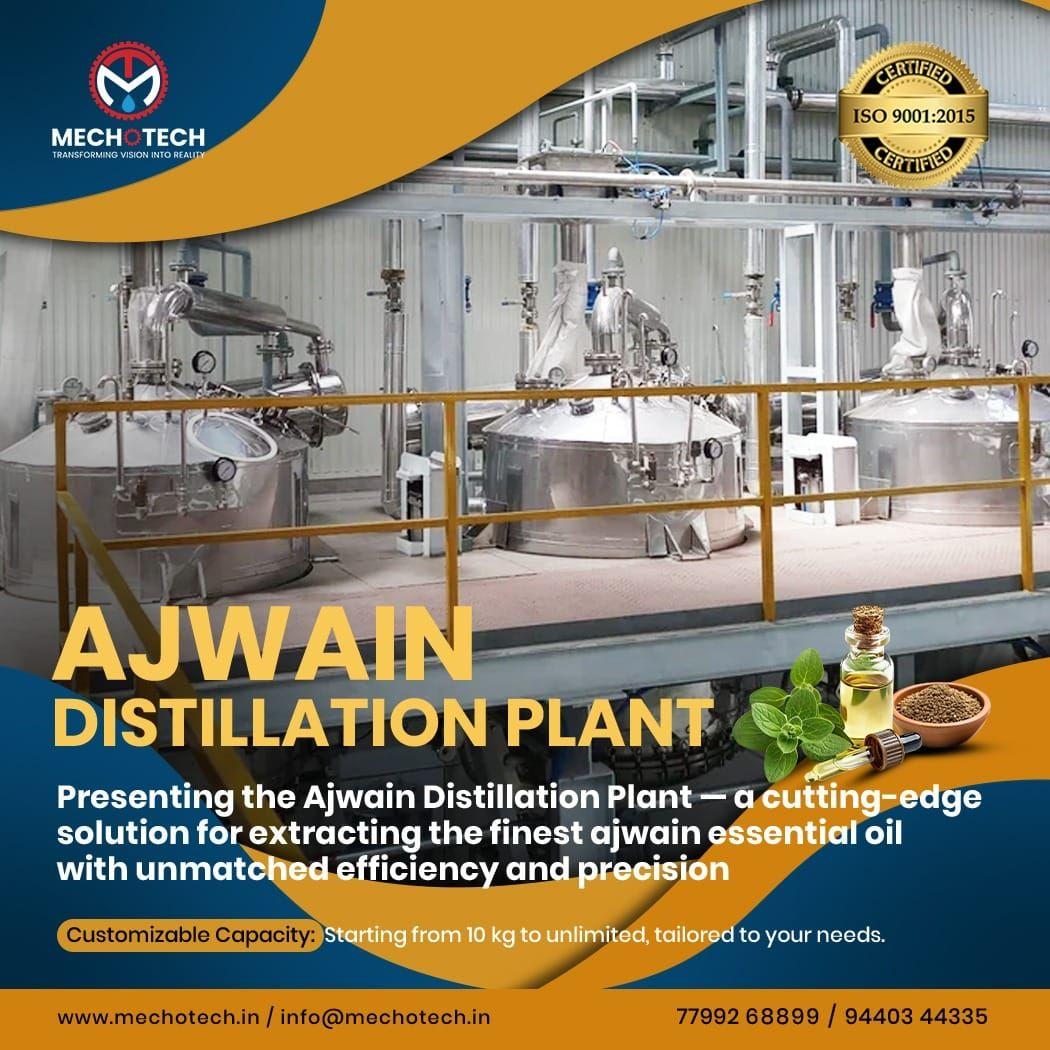
- →Mechotech supplies ajwain distillation plants from 100 kg/batch (copper, artisan-scale) to 5,000 kg/batch (SS 316L, GMP pharmaceutical), with optional integrated thymol crystallisation stages for pharmaceutical-grade product.
1Why is Ajwain Essential Oil So Valuable?
Ajwain essential oil, derived from the seeds of Trachyspermum ammi, is one of the highest natural sources of thymol — typically 35–55% of total oil composition, with p-cymene (15–28%) and γ-terpinene (10–20%) making up much of the balance. Carvacrol content varies significantly by geographic origin and season, from near-zero in most Indian varieties to 10–15% in some Pakistani or Egyptian accessions. The high thymol concentration is what drives the oil's value across multiple industries simultaneously — no single-target essential oil; a genuine multi-sector raw material.
- Pharmaceutical and Antiseptic Applications: Thymol's antimicrobial potency — documented at approximately 5× that of carbolic acid — makes ajwain oil a primary natural source for pharmaceutical-grade thymol used in surgical antiseptic hand scrubs, wound irrigation solutions, and specialised applications including antifungal nail treatments. Thymol is the active ingredient in Listerine mouthwash and several other dental antiseptic preparations marketed globally, and pharmaceutical buyers routinely specify a minimum thymol content of 40% (GC-MS verified) in purchase contracts for ajwain oil destined for thymol isolation. The compound also demonstrates documented anthelmintic (deworming) activity, positioning it as a veterinary pharmaceutical active.
- Culinary Applications: Ajwain oil is approved as a GRAS natural flavouring under FDA 21 CFR Part 182 and as a natural flavouring under EU Regulation 1334/2008, enabling its use in Indian spice blends, pickles (achaar), curry powders, and savoury snack seasonings. Typical usage levels in finished food products are 5–50 ppm — at these concentrations, a single kilogram of high-purity ajwain oil can flavour 20,000–200,000 kg of finished product. This concentration factor makes high-purity oil economically compelling for food ingredient buyers compared to raw seed.
- Pharmaceutical Formulations: Beyond thymol as an isolated active, whole ajwain oil is incorporated directly into Ayurvedic and allopathic topical formulations for carminative action (digestive relief), anti-spasmodic balms, and chest rub preparations. The combination of thymol and p-cymene in the natural oil produces a synergistic anti-spasmodic effect that some formulators prefer over isolated synthetic thymol — a 'synergy advantage' that is commercially documented and increasingly valued by natural-formulation pharmaceutical buyers.
- Personal Care and Dental Products: Thymol is the key active in antiseptic mouthwashes, toothpastes including Colgate Herbal variants, and dental irrigants used for pericoronitis and gum disease treatment. Cosmetic-grade ajwain oil (thymol 40%+, <5 ppm pesticide residues) is used in scalp treatment serums and antifungal foot care formulations. In Europe and the USA, thymol sourced from ajwain distillation must meet European Pharmacopoeia (EP) or USP monograph specifications — these are routinely achievable from well-operated Indian distillation plants with validated GC-MS testing.
2Ajwain Oil Composition and Distillation Parameters
The commercial value of ajwain essential oil is defined entirely by its thymol content, which is established by GC-MS analysis of each distillation batch. Understanding the relationships between distillation parameters — temperature, duration, and particle size — and the thymol yield in the finished oil is essential for operating a profitable plant.
- Oil Composition: Thymol, p-Cymene, and γ-Terpinene: The principal components of ajwain essential oil are thymol (35–55%), p-cymene (15–28%), and γ-terpinene (10–20%). These three compounds are biosynthetically related — γ-terpinene and p-cymene are the immediate monoterpene precursors and co-metabolites of thymol in the plant's secondary metabolic pathway. The relative ratios are influenced by harvest maturity (fully mature seeds have higher thymol content), geographic origin, and altitude of cultivation. Rajasthan and Gujarat varieties typically deliver 40–55% thymol; varieties from higher-altitude regions of Himachal Pradesh may show altered ratios. Carvacrol, the structural isomer of thymol, is typically present at less than 5% in Indian commercial varieties.
- Distillation Parameters and Oil Yield: Ajwain seeds are distilled by hydro-distillation (seeds and water together in the still) or steam distillation (steam passed through a bed of seeds on a perforated plate), both at 100–105°C still temperature for a duration of 3–4 hours per batch. Oil yield from well-conditioned dry seeds (8–10% moisture content) is 2–4% v/w — significantly higher than many other spice essential oils, where 0.5–2% is typical. The higher yield makes ajwain economically attractive: 100 kg of seeds yields 2–4 litres of oil at a bulk value of ₹2,000–4,000 per litre at farmgate pricing, representing ₹4,000–16,000 of oil value from ₹8,000–12,000 of seed input at current market prices. Pre-crushing the seeds to 1–2 mm particle size before charging the still reduces distillation time by 30–40% and improves oil recovery from the seed matrix.
- Thymol Isolation by Fractional Crystallisation: Pharmaceutical-grade thymol can be isolated from crude ajwain oil by chilled crystallisation — a simple and elegant downstream step that dramatically upgrades product value. Thymol has a melting point of 51°C and a freezing point of approximately 48–50°C under atmospheric pressure. When crude ajwain oil is cooled to 0–5°C in a jacketed crystallisation vessel over 4–6 hours, thymol crystallises preferentially from the liquid oil matrix while the liquid-at-room-temperature components (p-cymene, γ-terpinene) remain in solution. Draining the mother liquor and washing the crystals with cold hexane yields thymol at 95–99% purity after a single recrystallisation stage — meeting EP and USP monograph specifications without the need for complex chromatographic purification.
3Mechotech's Advanced Ajwain Distillation Technology
Mechotech's ajwain distillation plants are designed around the specific processing requirements of Trachyspermum ammi seeds — including the high oil content (which requires adequate vapour space above the charge), the dense thymol fraction (which is more miscible with water than lighter terpenes and requires careful Florentine flask management), and the optional downstream thymol crystallisation step for pharmaceutical-grade product extraction. Our plants are supplied in batch sizes from 100 kg per charge (pilot scale) to 5,000 kg per charge (commercial scale), all with the same core engineering principles.
- Material of Construction: Copper or SS 316L: Traditional ajwain oil distillation uses copper pot stills, and copper remains the material of choice for artisan-scale and premium essential oil production because trace copper catalyses the formation of desirable ester notes in the finished oil profile. However, for GMP pharmaceutical-grade thymol production, SS 316L construction throughout — still, goose-neck, condenser, and Florentine flask — is mandatory to prevent metal contamination and to satisfy pharmaceutical regulatory requirements. Mechotech offers both copper and SS 316L configurations, with the pharmaceutical GMP-grade SS 316L option including documented material certificates (EN 10204 3.1) for all wetted parts.
- Innovative Heating Systems and Energy Efficiency: Our ajwain plants use direct steam injection (for hydro-distillation of smaller batches) or indirect steam coils (for steam distillation of larger batches), with steam generation from either dedicated boilers or connection to existing site steam infrastructure. Heat integration — routing exhaust steam from the still to preheat incoming water for the next batch — reduces net steam consumption by 20–30% per batch. PLC-controlled steam flow regulation maintains the distillation temperature within ±2°C of the 100–105°C target, ensuring batch-to-batch thymol yield consistency without manual intervention.
- Florentine Flask with Thymol-Crystallisation Option: The condensed ajwain oil and hydrosol water are separated in a stainless steel Florentine flask. Ajwain oil (specific gravity 0.898–0.912 at 25°C) is lighter than water and collects in the upper layer, drained from a top-side port. For clients targeting pharmaceutical thymol isolation, the crude oil receiver is jacketed and connected to a chilled water supply, enabling immediate post-distillation cooling of the collected oil to 0–5°C for thymol crystallisation in the same vessel — eliminating a separate crystallisation tank and reducing product handling steps.
- Modular Design for Scalability: Mechotech's ajwain distillation plants are supplied in modular configurations from 100 kg/batch (₹8–15 lakhs) for artisan and pilot operations through 500 kg/batch (₹25–40 lakhs) for medium commercial scale, to 5,000 kg/batch (₹1.5–3 crore) for large industrial producers. The modular design allows a single additional still to be added to an existing installation without major civil works, enabling capacity expansion in response to confirmed order growth rather than speculative investment.
4Why Mechotech's Ajwain Plant is the Right Choice
With nearly three decades of experience designing essential oil and oleoresin processing plants from our Hyderabad base, Mechotech has developed specific process knowledge around the thymol-rich chemistry of Trachyspermum ammi that generic still manufacturers cannot replicate. From seed preparation to thymol crystallisation, every step of our plant design is informed by validated batch data from operating installations.
- Advanced Technology for Maximum Thymol Yield: Our steam distillation systems are specifically optimised for 3–4 hour cycle times at 100–105°C — the parameters that maximise total volatile oil recovery while limiting thermal degradation of the more temperature-sensitive minor oil components. Pre-crushing options (roller or disc mill integration) can be added as standard for clients processing large commercial volumes where the 30–40% cycle time reduction justifies the milling investment. Guaranteed minimum oil yield of 2.0% from correctly dried seeds (8–10% moisture, verified on receipt) is built into our plant performance guarantees.
- Customisable for All Business Sizes: From artisan-scale 100 kg/batch copper pot stills for craft essential oil production through to 5,000 kg/batch SS 316L GMP pharmaceutical plants — Mechotech engineers the correct scale with the correct material specification. All plants include Florentine flask oil separators, distillation hydrosol collection tanks (hydrosol has secondary commercial value as an antimicrobial rinse in some food applications), and oil storage in SS drums with nitrogen blanket to prevent oxidation of thymol-rich oil during storage.
- Commitment to Sustainability: Spent ajwain marc after distillation retains dietary fibre, fixed fat, and residual protein with value as livestock feed additive or composting input. Our plant designs include a marc press stage to recover absorbed water and residual oil before final marc discharge, improving total oil yield by an additional 0.2–0.5% and reducing marc moisture content from 60–70% wet to 30–40% wet for easier handling and transport.
- Comprehensive Support: From site assessment and civil layout planning through equipment installation, commissioning, operator training on distillation parameters, and ongoing remote process support — Mechotech provides full lifecycle support with a dedicated process engineer assigned to each project. Annual GC-MS calibration checks, distillation parameter optimisation reviews, and batch yield benchmarking against reference data from comparable operating plants are included in our maintenance service contracts.
Frequently Asked Questions
What is ajwain essential oil and how is it produced?+
What is the thymol content of ajwain essential oil?+
What is the oil yield of ajwain seeds in steam distillation?+
What are the main industrial uses of ajwain essential oil?+
How does ajwain oil compare to other thymol-containing plants?+
Conclusion
The growing global demand for natural thymol — across pharmaceutical antiseptics, dental care, food preservation, and agricultural biocontrol — makes ajwain essential oil one of India's most commercially strategic spice essential oils. Mechotech's purpose-designed ajwain distillation plants, available in copper or GMP SS 316L configurations from 100 kg to 5,000 kg per batch, are engineered to extract the maximum thymol-rich oil yield from every charge while providing the batch documentation and GC-MS traceability that pharmaceutical and food grade buyers demand. Contact us to discuss your seed throughput requirement, target thymol specification, and whether pharmaceutical-grade thymol crystallisation is the right downstream step for your market.
Ready to Build Your Extraction Plant?
Mechotech engineers are ready to design the perfect plant for your application.
Get a Free Consultation.jpeg&w=1920&q=75)