.jpeg&w=1920&q=75)
Curcumin, the primary polyphenolic compound in turmeric (Curcuma longa), commands a global market of approximately USD 58 million growing at 12% CAGR — driven by surging demand for anti-inflammatory, antioxidant, and potential anticancer nutraceuticals across the US, European, and Japanese health supplement markets. Raw turmeric powder cannot satisfy industrial buyers' requirements for standardised, HPLC-verified curcuminoid content, which is why solvent extraction and multi-stage purification to 90% or 95% curcuminoids is the commercially necessary process for market access. The choice of turmeric variety is the first critical process decision: Alleppey finger turmeric from Kerala contains 5–7% curcuminoids and consistently yields higher output than Rajapore or Madras varieties at 2–3%, making variety sourcing a direct determinant of extraction economics. A well-designed curcumin extraction plant — with explosion-proof solvent handling for acetone, multiple-effect evaporation, and a jacketed crystalliser — can deliver 20–40 kg of 95% curcumin per tonne of dried turmeric powder at commercially viable operating cost.
✓Key Takeaways
- →Alleppey finger turmeric (5–7% curcuminoids) delivers 30–45 kg of 95% curcumin per tonne of dried powder — nearly double the yield from Rajapore or Madras varieties at 2–3%, making variety selection the primary yield lever.
- →Acetone (highest yield extraction) requires explosion-proof plant design throughout the solvent zone due to its 0°C flash point; ethanol is used where food-regulatory compliance mandates an approved solvent.
- →The six-stage process — grinding to 60–80 mesh, solvent extraction, filtration, multiple-effect falling-film evaporation, crystallisation, spray drying — determines both yield and final purity grade.
- →Three grades are commercially traded: 90% curcuminoids (nutraceutical), 95% curcuminoids (pharmaceutical), and water-dispersible (nano-emulsified, 3–5× price premium for enhanced bioavailability).
- →Quality release testing includes HPLC curcuminoid content, residual solvent by headspace GC-MS per ICH Q3C, heavy metals by ICP-MS, and microbial limits per USP/FSSAI standards.
- →The global curcumin market at USD 58 million growing at 12% CAGR creates strong commercial rationale for investment in well-engineered extraction capacity — Mechotech has designed curcumin plants from 500 kg/day to 10 tonnes/day since 1997.
1Curcumin Extraction: Key Steps in the Process
Commercial curcumin extraction follows a six-stage process sequence that begins with raw material selection and ends with tested, packaged finished product. Each stage must be optimised to maintain curcumin bioactivity while achieving the target purity grade — pharmaceutical (95% curcuminoids), nutraceutical (90% curcuminoids), or water-dispersible (nano-emulsified for enhanced bioavailability). The process involves significant solvent handling — acetone (flash point 0°C) is the highest-yield solvent for curcumin extraction but requires explosion-proof plant design throughout — and multiple evaporation and crystallisation stages that determine final product purity. Quality control through HPLC analysis of the curcuminoid fraction (comprising curcumin, bisdemethoxycurcumin, and demethoxycurcumin) is conducted at multiple process stages to monitor extraction efficiency and purification progress.
- Sourcing High-Quality Turmeric: Variety selection is the single most impactful decision in curcumin extraction economics. Alleppey finger turmeric (5–7% curcuminoids, dry basis) from Kerala is the industry benchmark for high-yield commercial extraction; Rajapore and Madras varieties at 2–3% curcuminoids require significantly more raw material per kilogram of finished extract, raising both raw material cost and processing cost per unit output. Incoming turmeric is authenticated by identity testing (TLC or HPLC screening) and moisture determination; batches below 4% curcuminoid content on a dry basis may be rejected or blended.
- Grinding and Preparation: Dried turmeric roots or rhizomes are first cleaned to remove soil, stones, and foreign matter, then fed into a hammer mill or pin mill and ground to a particle size of 60–80 mesh (approximately 177–250 microns). This particle size provides sufficient surface area for efficient solvent penetration without creating an ultrafine powder that would cause filtration problems downstream. Moisture content is controlled below 8% before grinding to prevent milling difficulties and improve solvent extraction efficiency.
- Solvent Extraction: Acetone achieves the highest curcumin extraction yield from turmeric powder (typically 85–92% extraction efficiency in three counter-current washes) and is therefore the preferred solvent for commercial 95% curcumin production. Food-grade ethanol is used where the downstream product must be ethanol-extracted per regulatory requirement or customer specification; yield is somewhat lower (75–85% extraction efficiency) but ethanol's broader regulatory acceptance is advantageous. Hexane-alcohol mixtures are used for extracting a crude oleoresin-grade intermediate. Extraction is conducted in closed, agitated extractors with the miscella (solvent + dissolved curcuminoids) collected and filtered after each wash cycle.
- Concentration and Filtration: The filtered miscella passes through a falling-film evaporator — operating at 50–65°C under vacuum (50–80 mbar) — to concentrate the curcuminoid solution by removing 80–90% of the solvent volume. Falling-film evaporation is preferred over single-pass evaporation because its short residence time and low temperature exposure minimise thermal degradation of curcuminoids. The concentrated crude extract at this stage typically contains 20–40% curcuminoids and requires further purification to reach the commercial specification.
- Purification and Crystallisation: The concentrated crude extract is dissolved in hot ethanol and subjected to recrystallisation — the primary purification step for achieving 95% curcuminoids pharmaceutical grade. The solution is cooled in a jacketed crystalliser vessel (typically to 0–5°C at controlled cooling rate) to precipitate curcumin crystals with high purity, while impurities remain in the mother liquor. The crystals are separated by centrifugation, washed with cold ethanol to remove residual impurities, and transferred to a tray dryer or spray dryer. Multiple recrystallisation cycles can push purity above 97% for speciality pharmaceutical applications.
- Final Product Formulation and Testing: Dried curcumin crystals are milled to specification particle size, blended for batch homogeneity, and subjected to full quality testing before release: HPLC curcuminoid content (curcumin + demethoxycurcumin + bisdemethoxycurcumin), residual solvent by headspace GC-MS per ICH Q3C limits (acetone 5,000 ppm Class 3, ethanol 5,000 ppm Class 3), heavy metals by ICP-MS, microbial limits by USP/FSSAI methods, and moisture by Karl Fischer. Water-dispersible curcumin (for enhanced bioavailability formulations) is produced by nano-emulsification or phytosome complexation of the purified curcumin before spray drying.
2Why the Right Extraction Technology Matters
A well-designed curcumin extraction plant delivers consistent 95% curcuminoid purity at optimal yield per tonne of raw material — and the engineering decisions embedded in the plant design determine whether that standard is achievable economically and sustainably. Acetone's flash point of 0°C means the entire solvent handling zone must be explosion-proof certified (PESO or ATEX equivalent) — agitators, pumps, valves, instrumentation, and electrical fittings all operating in a Zone 1 or Zone 2 hazardous area classification. A multiple-effect evaporator — where the vapour from the first evaporation stage serves as the heat source for the second — reduces steam consumption by 40–50% compared to a single-effect system, materially improving operating economics at commercial scale. The crystalliser design — jacket temperature control, cooling rate, seed crystal addition — directly determines crystal purity and filtration performance, and an improperly designed crystalliser is the most common cause of yield losses and purity failures in curcumin plants.
- Explosion-Proof Design for Acetone Handling: Acetone (flash point 0°C) is classified as a highly flammable liquid, and all plant areas where acetone vapour may be present must be classified as hazardous zones with explosion-proof motors, instrumentation, and fittings. Plants designed without this specification are a fire and explosion risk and will fail regulatory site inspection under Indian Petroleum Act and Factory Act requirements. We build all curcumin extraction plants with certified explosion-proof design throughout the solvent zone as standard.
- Multiple-Effect Evaporator: A triple-effect falling-film evaporator recovers solvent at 40–50% lower steam consumption than a single-effect system — a critical operating cost advantage for a plant evaporating large solvent volumes per batch. The falling-film design with short residence time also minimises curcuminoid thermal degradation during concentration, preserving the purity and colour quality of the concentrated extract before crystallisation.
- Jacketed Crystalliser for Purity Control: The jacketed crystalliser with precise temperature ramp control is the key equipment for achieving consistent 95% curcuminoid purity. Cooling rate, final crystallisation temperature, and agitation speed determine crystal size distribution, purity, and centrifugation performance. A well-controlled crystallisation cycle produces large, clean crystals that filter and wash easily; a poorly controlled cycle produces fine crystals with high impurity inclusion that cannot be washed to specification.
3Mechotech's Curcumin Extraction Plants
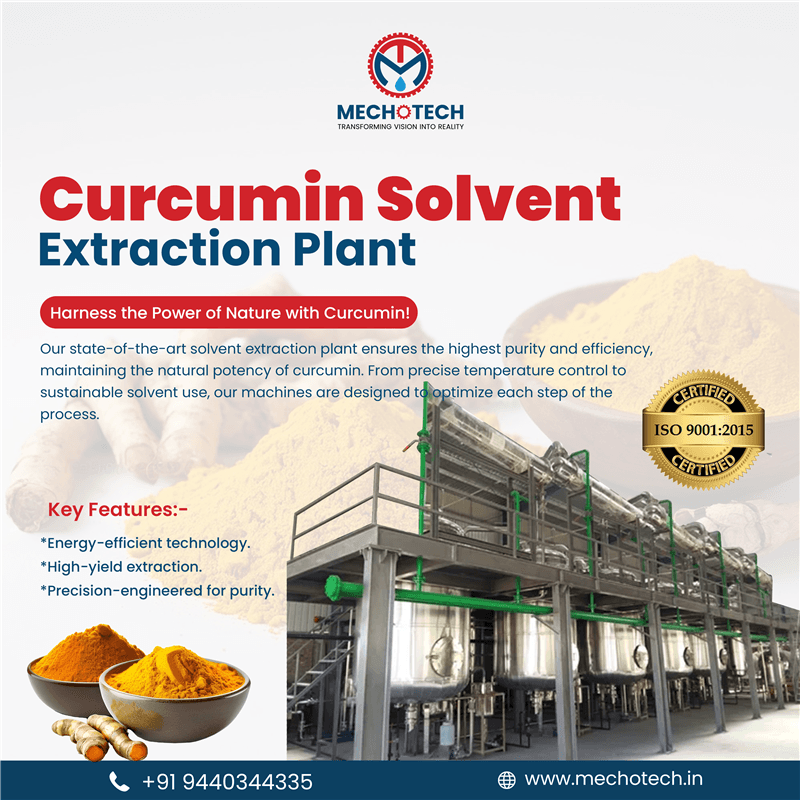
We have designed and commissioned curcumin extraction plants across India since 1997, serving pharmaceutical API manufacturers, nutraceutical producers, and natural colour manufacturers. Our plants are engineered around the specific physical and chemical properties of turmeric and curcuminoids — acetone's hazardous area classification, curcumin's sensitivity to alkaline conditions and UV light, the viscosity profile of concentrated curcuminoid solutions during evaporation, and the recrystallisation behaviour that determines final product purity. Standard plant offerings range from 500 kg/day turmeric throughput for pilot and product development applications to 10 tonnes/day commercial plants for established extract exporters.
- Advanced Technology: Our curcumin extraction plants incorporate multi-effect falling-film evaporators, jacketed crystallisers with programmable cooling ramp control, centrifuges sized for the crystal characteristics of curcumin, and spray dryers with closed-loop nitrogen inert blanket for colour-sensitive product handling. Every equipment selection is driven by the specific process chemistry of curcumin, not generic herbal extraction design.
- Customisable Solutions: Plants are configurable for the target purity grade — 90% nutraceutical grade (single crystallisation), 95% pharmaceutical grade (double crystallisation), or water-dispersible curcumin with downstream nano-emulsification. Solvent system is selected based on regulatory requirements of the target market: acetone for maximum yield, ethanol for food-regulatory compliance, or mixed systems for specific intermediate products.
- Cost-Effective Operations: Closed-loop solvent recovery with greater than 95% efficiency, multiple-effect evaporation for minimum steam consumption, and condensate heat recovery are integrated into the plant design to minimise operating cost per kilogram of finished curcumin extract. For a commercial plant processing 5 tonnes of turmeric powder per day, these efficiencies translate to meaningful reductions in both solvent and utility cost.
- Sustainable Design: Curcumin extraction generates spent turmeric marc (the extracted solids) — approximately 96–97% by weight of the original powder — which retains residual colouring matter and fibre. Our plants include spent marc handling systems and clients are advised on marc utilisation options including animal feed, fibre extraction, or biomass fuel, avoiding landfill disposal and converting a waste stream into a secondary revenue source.
- High Yield and Purity: A Mechotech curcumin extraction plant operating on Alleppey finger turmeric (5–7% curcuminoids) with acetone extraction and double recrystallisation consistently delivers 95%+ curcuminoids at 20–40 kg per tonne of dry turmeric input, depending on incoming raw material quality. This yield range is validated against our commissioned plant operational data, not theoretical extraction calculations.
4Market Context and Quality Standards for Commercial Curcumin
The global curcumin extract market — valued at approximately USD 58 million and growing at 12% CAGR — is driven primarily by nutraceutical demand in the United States, Europe, and Japan, where curcumin is among the top-selling botanical supplements. India is both the world's largest turmeric producer (accounting for approximately 75% of global supply) and the dominant curcumin extract exporter, making it the natural location for curcumin extraction investment. Three distinct grades are traded globally, each with specific quality requirements, buyer specifications, and price points — and each requires a somewhat different extraction and purification process sequence.
- 95% Curcuminoids — Pharmaceutical Grade: The pharmaceutical standard requires HPLC-verified curcuminoid content of not less than 95% (combined curcumin, demethoxycurcumin, and bisdemethoxycurcumin), residual solvent below ICH Q3C Class 3 limits, heavy metals below USP/EP limits, and documented batch manufacturing records for each production run. This grade commands the highest market price and is required for clinical research applications and branded pharmaceutical nutraceutical products.
- 90% Curcuminoids — Nutraceutical Grade: Standard nutraceutical grade requires not less than 90% curcuminoids by HPLC, FSSAI or GRAS compliance for the extraction solvent, and heavy metal and pesticide testing per AOAC methods. This grade is used in dietary supplement capsules, tablets, and functional food products where the 95% pharmaceutical threshold is not required. Single recrystallisation typically achieves 90% specification reliably from Alleppey finger turmeric starting material.
- Water-Dispersible Curcumin — Bioavailability-Enhanced Grade: Curcumin is highly lipophilic and poorly water-soluble, which limits its oral bioavailability from standard 95% extract formulations. Water-dispersible curcumin — produced by nano-emulsification, phytosome complexation (curcumin bound to phosphatidylcholine), or polymer encapsulation of purified curcumin — disperses in aqueous media and delivers significantly enhanced absorption in clinical studies. This premium grade commands a 3–5× price premium over standard 95% curcumin and targets the high-value branded supplement market.
Frequently Asked Questions
What is curcumin and why does it command a premium price?+
How many steps does the curcumin extraction process involve?+
What purity grades of curcumin are commercially produced?+
How much curcumin can be extracted from one tonne of turmeric?+
Which industries are the largest consumers of curcumin extract?+
Conclusion
Curcumin extraction from turmeric is a technically mature commercial process with a well-established six-stage sequence — grinding, solvent extraction, filtration, falling-film evaporation, crystallisation, and drying — but the profitability of the operation depends critically on engineering decisions at every stage: variety selection (Alleppey finger for maximum yield), solvent choice (acetone for yield, ethanol for regulatory flexibility), explosion-proof design throughout the acetone-handling zone, multiple-effect evaporation for operating cost control, and a precisely controlled crystalliser for consistent 95% purity. The global curcumin market's 12% CAGR growth trajectory, India's dominance of turmeric raw material supply, and strong export demand from pharmaceutical and nutraceutical buyers in developed markets make this a commercially attractive extraction business for manufacturers with the right plant technology. We have designed and commissioned curcumin extraction plants across India since 1997, and our engineering team can evaluate your raw material, target grade, and market requirements to recommend the optimal plant configuration for your investment.
Ready to Build Your Extraction Plant?
Mechotech engineers are ready to design the perfect plant for your application.
Get a Free Consultation