Curcumin — the bright yellow polyphenol that gives turmeric (Curcuma longa) its characteristic colour — has become the most extensively researched phytochemical in modern nutraceutical science, with over 12,000 peer-reviewed publications documenting its anti-inflammatory, antioxidant, neuroprotective, and potential anti-cancer properties. The global curcumin extract market was valued at approximately USD 58 million in 2023 and is projected to grow at 12% CAGR through 2030, driven by rising consumer demand for natural anti-inflammatory supplements and pharmaceutical research into curcumin-based drug candidates. India produces approximately 80% of globally traded turmeric, with the major growing states being Andhra Pradesh, Telangana, and Maharashtra — making India the natural locus of cost-competitive curcumin extraction. Businesses investing in curcumin extraction infrastructure now position themselves at the centre of a high-growth global supply chain that shows no signs of consolidating around any single dominant supplier.
✓Key Takeaways
- →Curcumin extract (95% curcuminoids) comprises three compounds: curcumin (75–80%), demethoxycurcumin (15–20%), and bisdemethoxycurcumin (3–5%); pharmaceutical HPLC testing requires all three values to be declared separately.
- →Acetone extraction yields 7–9% curcuminoids from dried turmeric; ethanol yields 5–7%; water-based extraction recovers only 1–2% due to curcumin's extreme water insolubility.
- →Raw curcumin has less than 2% oral bioavailability; piperine co-formulation (BioPerine) increases absorption approximately 2,000%; phospholipid complexation (Meriva phytosome) achieves 29-fold improvement in clinical studies.
- →The global curcumin market is valued at USD 58 million (2023) growing at 12% CAGR; India produces 80% of global turmeric with Andhra Pradesh, Telangana, and Maharashtra as the primary growing states.
- →Mechotech curcumin plants span three scales: 200 kg/day pilot (₹30–50 lakhs), 2 TPD semi-commercial (₹1.5–2.5 crore), and 10 TPD commercial (₹4–8 crore) — all with GMP documentation, solvent recovery, and crystallisation purification.
- →Quality release testing includes HPLC curcuminoid profile (USP method), residual solvent GC (ICH Q3C), heavy metals by ICP-OES (USP <232>), and microbial counts (TAMC ≤10³ CFU/g, yeast and mould ≤10² CFU/g).
1Why Curcumin is in Such High Demand
Curcumin is not a single compound but a mixture of three related curcuminoids: curcumin itself (75–80% of total curcuminoids in commercial extracts), demethoxycurcumin (15–20%), and bisdemethoxycurcumin (3–5%). The 95% curcuminoids specification widely used in commerce refers to the total concentration of all three compounds, each of which has demonstrated independent biological activity. This nuance matters commercially because buyers performing their own HPLC testing will measure total curcuminoids — and an extract meeting the specification for curcumin alone but deficient in the demethoxy compounds will fail buyer acceptance testing despite appearing compliant on a single-marker basis.
- Pharmaceuticals: Anti-inflammatory pharmaceutical applications of curcumin exploit its potent inhibition of nuclear factor κB (NF-κB) — a transcription factor central to the inflammatory cascade — and its direct scavenging of reactive oxygen species (ROS). Phase II and Phase III clinical trials are underway for curcumin-based formulations targeting inflammatory bowel disease, rheumatoid arthritis, and adjunctive cancer therapy. Pharmaceutical buyers require curcuminoid profiles verified by HPLC against USP Reference Standards, with individual curcumin, demethoxycurcumin, and bisdemethoxycurcumin values declared separately.
- Nutraceuticals: The nutraceutical market consumes the largest volume of 95% curcuminoids extract globally. Supplement formulations targeting joint health, cognitive function, and general anti-inflammatory wellbeing are sold across the USA, EU, Japan, and Australia at price points ranging from mass market (commodity 95% curcuminoids) to premium (enhanced bioavailability formats). Because raw curcumin has less than 2% oral bioavailability when consumed alone, manufacturers require the 95% standardised extract as the starting material for downstream bioavailability enhancement — piperine co-formulation (BioPerine), phospholipid complexation (Meriva phytosome), nanoparticle encapsulation, or liposomal formulation.
- Cosmetics: Curcumin's antioxidant capacity — measured at approximately 10× the radical scavenging activity of vitamin E — makes it attractive in anti-aging skin care formulations targeting UV-induced oxidative damage and collagen degradation. Water-dispersible curcumin grades (produced by cyclodextrin encapsulation or phospholipid complexation) solve the formulation challenge of incorporating the highly water-insoluble raw curcumin into aqueous cream and serum bases. EU cosmetics regulations permit curcumin (CI 75300) as a colourant and active ingredient with no specific concentration restriction, provided the product is stable and non-sensitising.
- Food and Beverages: Curcumin (E100 in the EU, GRAS in the USA) is approved as a natural yellow colourant in food and beverages, used in margarine, dairy products, mustard, savoury seasonings, and health food products. The food grade extract (typically 90–95% curcuminoids) is used at 1–100 mg/kg depending on the target colour intensity and food matrix. The global trend toward clean-label, naturally derived food colourants at the expense of synthetic alternatives (tartrazine, sunset yellow) continues to drive food industry demand for cost-competitive curcumin extract.
2Curcumin Extraction: Key Steps in the Process
The curcumin extraction process follows a precise validated sequence to achieve maximum yield and 95% curcuminoid purity. The choice of solvent is the single largest determinant of both yield and regulatory compliance in the finished extract — and the economics of solvent recovery directly determine plant profitability.
- Sourcing High-Quality Turmeric: Premium curcumin yield depends on raw material curcuminoid content — which varies from 2–5% in commodity market turmeric to 6–8% in selected high-curcumin varieties such as Alleppey finger (from Kerala, 5–7% curcuminoids) and Madras (from Tamil Nadu, 4–6% curcuminoids). Raw material authentication by HPTLC fingerprinting and curcuminoid content verification by HPLC on receipt is standard practice for pharmaceutical-grade production. Purchasing based on price alone — without incoming quality verification — is the most common cause of low finished-extract yield in new operations.
- Grinding and Preparation: Dried turmeric rhizomes are milled to a fine powder of 40–80 mesh (180–420 micron) to maximise solvent-accessible surface area. Pre-milled turmeric flour from certified suppliers is used by many extraction plants to avoid the capital and operating cost of in-house milling, and because commercial turmeric milling infrastructure in Andhra Pradesh and Telangana is well established with quality-certified suppliers. The milling step increases extraction yield by 20–30% compared to coarsely broken rhizome at the same solvent ratio and contact time.
- Solvent Extraction: Acetone is the highest-yielding solvent for curcumin extraction, delivering 7–9% curcuminoids from turmeric containing 5% curcuminoids — a recovery efficiency of approximately 75–80% of the theoretical maximum. Food-grade ethanol at 95% yields 5–7% curcuminoids from the same raw material; water-based extraction recovers only 1–2% due to curcumin's extreme water insolubility (less than 11 ng/mL at pH 7). Extraction is conducted at 50–60°C for 2–4 hours at a turmeric-to-solvent ratio of 1:6 to 1:8 (w/v) with continuous agitation. Two to three successive extraction stages are performed on each batch of marc to approach complete curcuminoid recovery.
- Concentration and Filtration: The combined miscella from all extraction stages is filtered through a three-stage cascade (plate-and-frame press, sparkler filter, 5-micron cartridge) to remove plant particulates before concentration. Falling-film evaporation at 55–65°C under vacuum (0.05–0.08 bar) concentrates the miscella from 5–8% dissolved solids to 30–40% dissolved solids with solvent recovery exceeding 95%. The concentrated extract at this stage is a dark orange-brown paste containing 40–60% curcuminoids — the starting material for the purification and crystallisation step.
- Purification and Crystallisation: Curcumin is further purified from the concentrated extract by selective crystallisation: the paste is dissolved in minimum hot acetone or ethanol, then cooled slowly to 5–10°C over 6–8 hours with controlled agitation. Curcumin crystallises preferentially from the cooler solution while the residual plant pigments, oils, and minor components remain in solution. The crystals are filtered, washed with cold solvent, and dried to produce 95% curcuminoids extract. Multiple recrystallisation stages are used to produce 98%+ purity curcumin for specific pharmaceutical applications.
- Final Product Formulation and Testing: Finished curcuminoid powder is tested by HPLC (USP method, 425 nm detection) for the individual profile of curcumin, demethoxycurcumin, and bisdemethoxycurcumin before any product is released. Residual solvent is measured by GC headspace (acetone or ethanol within ICH Q3C limits). Lead, cadmium, and arsenic are quantified by ICP-OES per USP <232> limits. Total aerobic microbial count and yeast and mould are tested per USP <2021>. Only batches passing all parameters within specification are released for commercial sale.
3Bioavailability: The Critical Challenge for Curcumin Formulators
Raw curcumin has a well-documented oral bioavailability of less than 2% when consumed without a bioavailability enhancer — the result of poor aqueous solubility, rapid hepatic glucuronidation and sulphation, and rapid biliary excretion. This low bioavailability does not diminish the value of 95% curcuminoids extract; rather, it creates a downstream formulation opportunity that drives a separate, higher-margin segment of the curcumin value chain.
- Piperine Co-Formulation (BioPerine): Co-administration of piperine (20 mg, standardised black pepper extract trade-named BioPerine) with curcumin (2 g) has been documented in human pharmacokinetic studies to increase curcumin serum concentration by approximately 2,000% (20-fold). Piperine inhibits hepatic and intestinal glucuronidation enzymes that are the primary first-pass metabolism pathway for curcumin. This combination is the most widely used bioavailability enhancement approach in the supplement industry because it uses approved, inexpensive food-grade ingredients with an established clinical data package.
- Phospholipid Complexation (Meriva Phytosome): The Meriva phytosome technology complexes curcumin with phosphatidylcholine (soy lecithin) in a 1:2 molar ratio to form a curcumin-phospholipid complex that is substantially more lipophilic and better absorbed through the intestinal mucosa. Clinical studies have reported 29-fold higher curcumin absorption relative to uncomplexed 95% curcuminoids, with significantly improved outcomes in joint pain clinical trials. Phytosome production requires an additional processing step (solvent complexation and spray drying) that can be integrated into curcumin extraction plant design for manufacturers targeting this premium format.
- Nanoparticle Encapsulation and Liposomal Formulation: Nanoparticle encapsulation (polymer matrix or lipid nanoparticle) reduces curcumin particle size to 100–300 nm, dramatically increasing the surface area available for dissolution and absorption. Liposomal curcumin formulations encapsulate curcumin within phospholipid bilayer vesicles that mimic cell membranes, facilitating direct membrane fusion and intracellular delivery. Both formats command premium pricing — 3–5× standard curcumin extract price — and represent the frontier of curcumin formulation technology that pharmaceutical buyers are increasingly specifying.
4Mechotech's Curcumin Extraction Plants
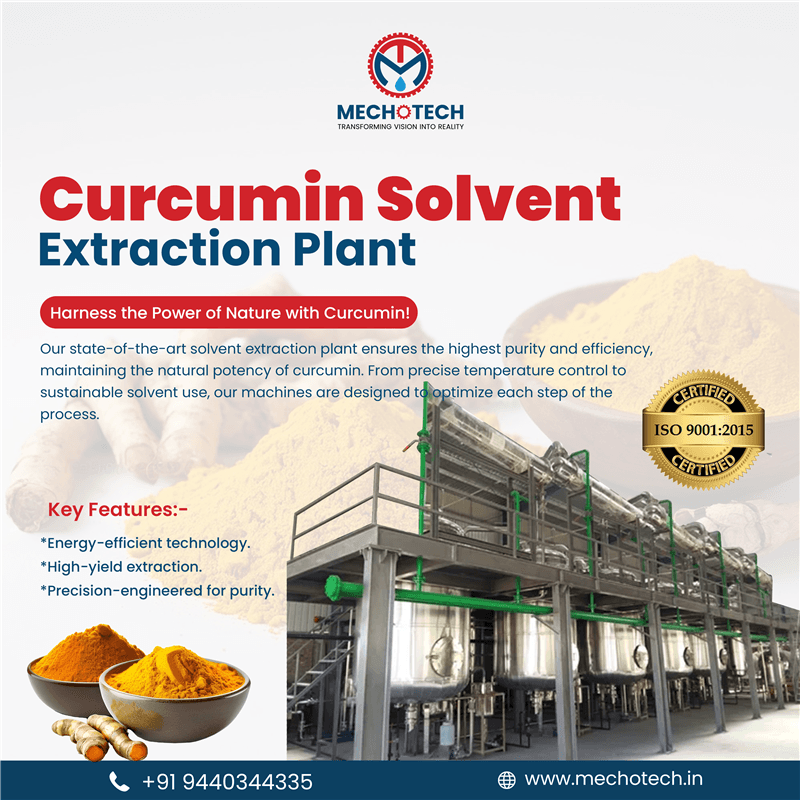
As the demand for curcumin continues to grow at 12% CAGR globally, businesses need reliable, GMP-compliant extraction solutions that can scale from initial market validation through full commercial production. Mechotech offers curcumin extraction plants across the full capacity range — from pilot-scale systems for new entrants testing the market to multi-tonne commercial plants for established ingredient suppliers.
- Pilot Scale: 200 kg/Day Turmeric Input: Our pilot curcumin extraction plant (200 kg/day turmeric input) processes 6 tonnes of dried turmeric per month, producing approximately 400–600 kg of 95% curcuminoids per month at an acetone extraction yield of 7%. Capital investment is in the range of ₹30–50 lakhs depending on site infrastructure, inclusion of spray drying, and GMP documentation scope. This scale is appropriate for businesses with confirmed initial purchase orders of 300–500 kg/month and a plan to scale once market position is established.
- Semi-Commercial Scale: 2 TPD Turmeric Input: The 2-tonne-per-day semi-commercial plant processes 60 tonnes of dried turmeric per month and produces approximately 4–5 tonnes of 95% curcuminoids monthly — a scale appropriate for established nutraceutical ingredient suppliers with contracted annual volumes. Capital investment is ₹1.5–2.5 crore, including falling-film evaporator, crystallisation vessels, centrifugal dryer, and spray drying option. At this scale, solvent recovery economics justify a dedicated closed-loop acetone recovery system that achieves 96–98% acetone return rate.
- Commercial Scale: 10 TPD Turmeric Input: The 10-tonne-per-day commercial plant is designed for large-scale ingredient producers supplying multiple pharmaceutical and nutraceutical buyers simultaneously. Processing 300 tonnes of dried turmeric per month, this plant produces 20–25 tonnes of 95% curcuminoids monthly — sufficient to supply a significant share of a major market buyer's annual volume. Capital investment is ₹4–8 crore, with the full configuration including continuous counter-current extraction, multi-effect falling-film evaporation for energy efficiency, multi-stage crystallisation, and integrated spray drying with cyclone separator.
- GMP-Compliant Design and Documentation: All Mechotech curcumin plants are supplied in SS 316L construction for all product-contact surfaces, with surface finish Ra ≤0.8 micron on vessel interiors to meet GMP cleaning validation requirements. Full documentation packages include P&ID drawings, equipment qualification protocols (IQ/OQ/PQ), standard operating procedures, cleaning validation protocols, and batch record templates aligned with FDA 21 CFR Part 111 (dietary supplement cGMP) and EU GMP Annex 15. The documentation package is prepared in English and is reviewed by our regulatory team against the specific market requirements of your target buyers before delivery.
Frequently Asked Questions
Why is curcumin called turmeric's "golden compound"?+
Why is curcumin's bioavailability a challenge for supplement manufacturers?+
How does curcumin extract differ from standard turmeric powder?+
What is the daily capacity of a typical curcumin extraction plant in India?+
What is the global market size for curcumin extract?+
Conclusion
With the right extraction technology and process parameters, curcumin production from Indian turmeric is one of the most commercially compelling herbal extraction opportunities available today — combining India's dominant raw material position (80% of global turmeric production), a large and growing global market (USD 58 million, 12% CAGR), and established pharmaceutical and nutraceutical buyer networks hungry for quality-compliant supply. Mechotech's curcumin extraction plants — from ₹30 lakh pilot systems to ₹8 crore commercial configurations — are engineered for the specific chemistry of curcuminoid extraction, with acetone solvent optimisation, crystallisation purification, and GMP documentation as standard. Contact us at info@mechotech.in or call +91 77992 68899 to discuss your raw material access, target curcuminoid specification, and the plant scale that your market demand justifies.
Ready to Build Your Extraction Plant?
Mechotech engineers are ready to design the perfect plant for your application.
Get a Free Consultation.jpeg&w=1920&q=75)